
As you know, I’m always looking for new ways to use knitting yarn and explore colour, especially hand-dyed colour. And this year, I have made it my goal to learn new crafts, things that I’ve been curious about, but never really had a moment to stop and try. And one of those new crafts is Tunisian crochet.
I have to say, learning Tunisian crochet has been a little bit of an adventure for me, so I wanted to share my experience with you. Everything from the good, the tricky, and the “throw it in the corner for a time out” moments, because I think there is value in showing the messy middle of learning something new.
New Craft, New Tools
So, first things first, we need to talk about the tools. If you want to learn how to do Tunisian crochet, you don’t necessarily need to acquire any specific Tunisian crochet hooks. You can use a regular crochet hook with a small number of stitches to get started and try the technique. If you are going to make something wider than two or three inches, you will need a Tunisian crochet hook, which is a crochet hook that either has a very long stem, like a long straight knitting needle, or it has a flexible cord that is attached to the crochet hook so that there is room for the stitches to sit.
I decided to work with the Tunisian crochet hook set from Clover. This interchangeable set has different hook sizes and flexible nylon cords to screw onto the base of each hook. They are great to work with so far, but I don’t have anything to compare them to. I purchased the Clover set because it was inexpensive and the most accessible set I could get. If I do continue down this path of Tunisian crochet, I might invest in a hook with a smoother surface, made in a different material.
My preference when I’m knitting is to use ChiaGoo Stainless Steel Needles, and it would be great to have a similar metal Tunisian crochet hook set, but I couldn’t find any good options. The Lantern Moon Wooden Tunisian Crochet Hooks look fairly smooth and sleek, so those might be a possibility.

New Craft, New Techniques
Crochet is obviously not the same as knitting. I feel like knitting is very straightforward, because you can always see the stitches you are going to be working with. If you have 10 stitches on your needle, you have 10 working stitches.
With crochet, you really only have one live loop that you’re working with. All the stitches that you’re making are created by inserting the crochet hook into the fabric to pull up a loop, and this creates a new stitch.
With Tunisian crochet, you make two passes to make one row of stitches. Pass one: from right to left, you insert the crochet hook into the fabric, pull up a loop of yarn, and the loop stays on the shaft of the hook, and repeat. Pass two: you insert the hook into the fabric and pull up a loop, and work it through one of the stitches on the hook, left to right, continuing until you have completed the row.
Where you insert the crochet hook into the fabric determines the style and appearance of the stitch and fabric. So it’s essential to be able to “read” your crochet fabric to see where to insert the crochet hook.
New Craft, New Projects
First Attempt: Sock Blank Scarf
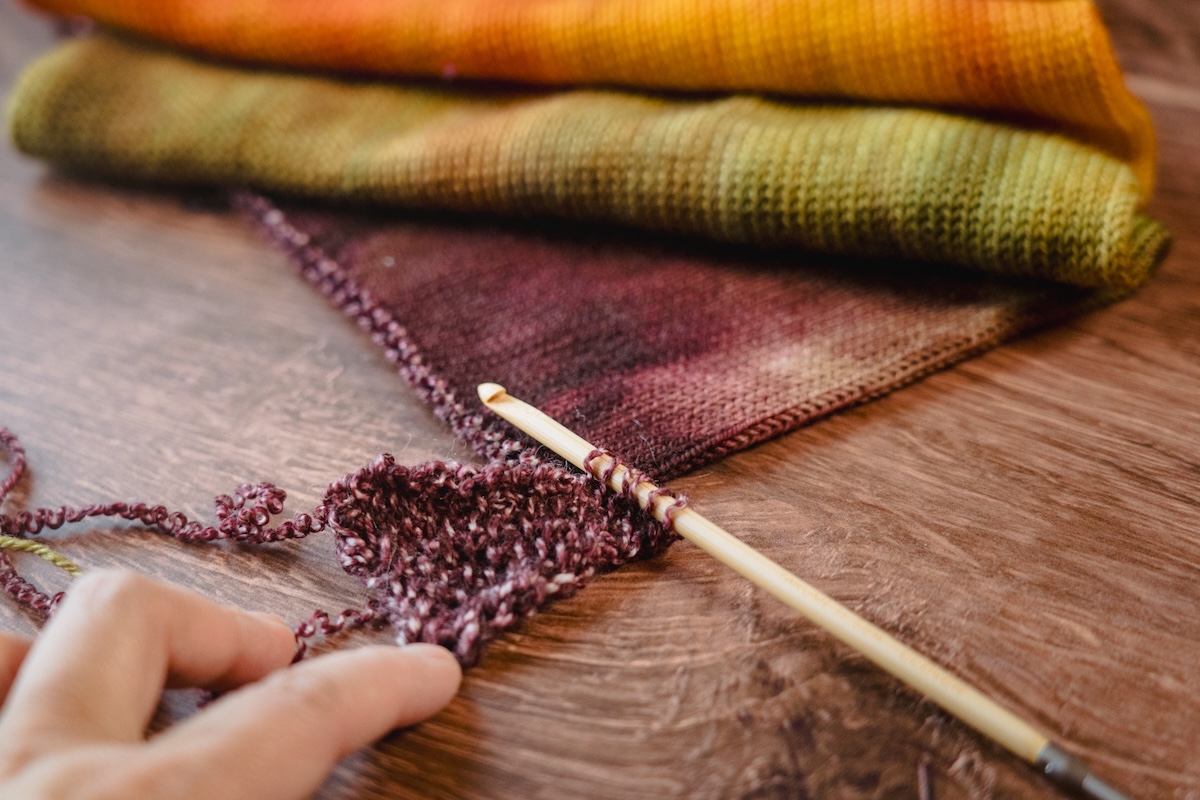
While looking through my stash, I became inspired to crochet a corner-to-corner bias scarf using a hand-dyed sock blank. The idea is to cast on one or two stitches, then increase at each edge until the desired width. Next, increase one side while decreasing the other, continuing in this manner to maintain the bias scarf appearance. Then, decreasing on both sides, like how the scarf started.
The sock blank is made from fingering-weight yarn, which is quite fine, so I used a small-sized hook to match. The side of the sock blank I was working on was dark brown. This made it really hard to see my stitches and where to insert the hook. I started making a lot of mistakes (and I got a little bit more frustrated than I should). I quickly realized I was probably fighting two battles at once: trying to learn the technique AND working with a fine, dark, crinkly yarn at the same time.
So while I love hand-dyed sock blanks for projects like weaving or knitting, I decided to switch projects and also switch yarns.
Second Attempt: Merino DK Cowl
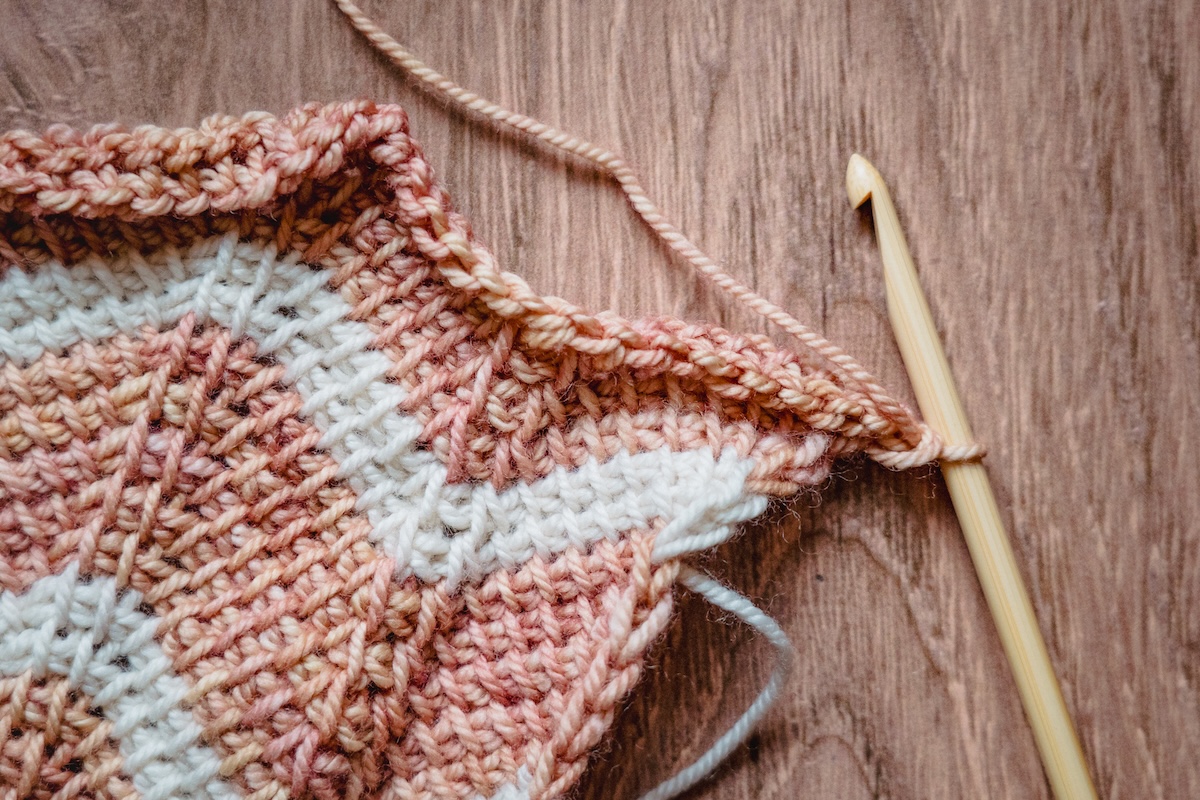
I started the Juvie Cowl, a pattern by Toni Lipsy from TL Yarn Crafts, from her fantastic new book, The Tunisian Crochet Handbook, specifically designed for beginners. If you are looking for a great entry point into Tunisian Crochet, I really recommend checking it out. The patterns look very approachable, modern, and appealing, and the book is well written.
I decided to change yarns to our SweetGeorgia Merino DK, and it made a huge difference! The DK-weight yarn paired with bamboo Tunisian hooks was a very, very different experience. I could see the stitches more clearly, and the yarn moved really well with the hook. I finally felt like I could see what I was doing! It was a reminder that choosing the right materials for your skill level does matter. A thicker yarn is easier to work with when you’re learning a new technique or skill!
New Craft, New Mistakes
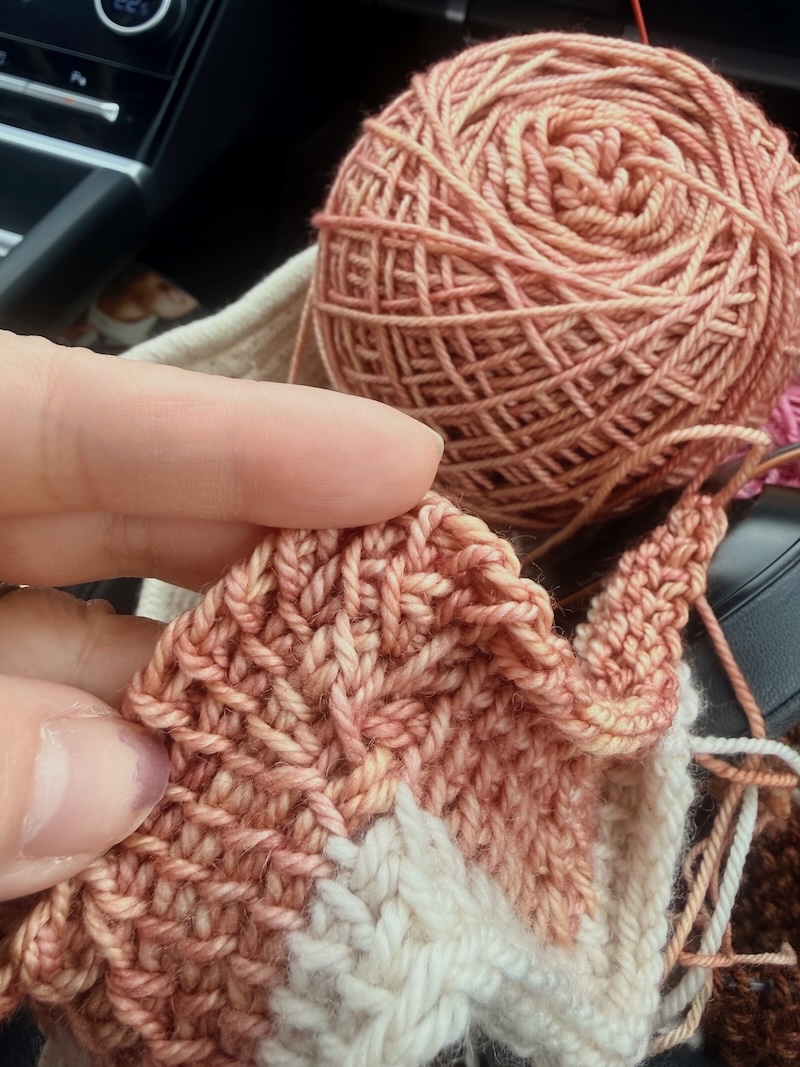
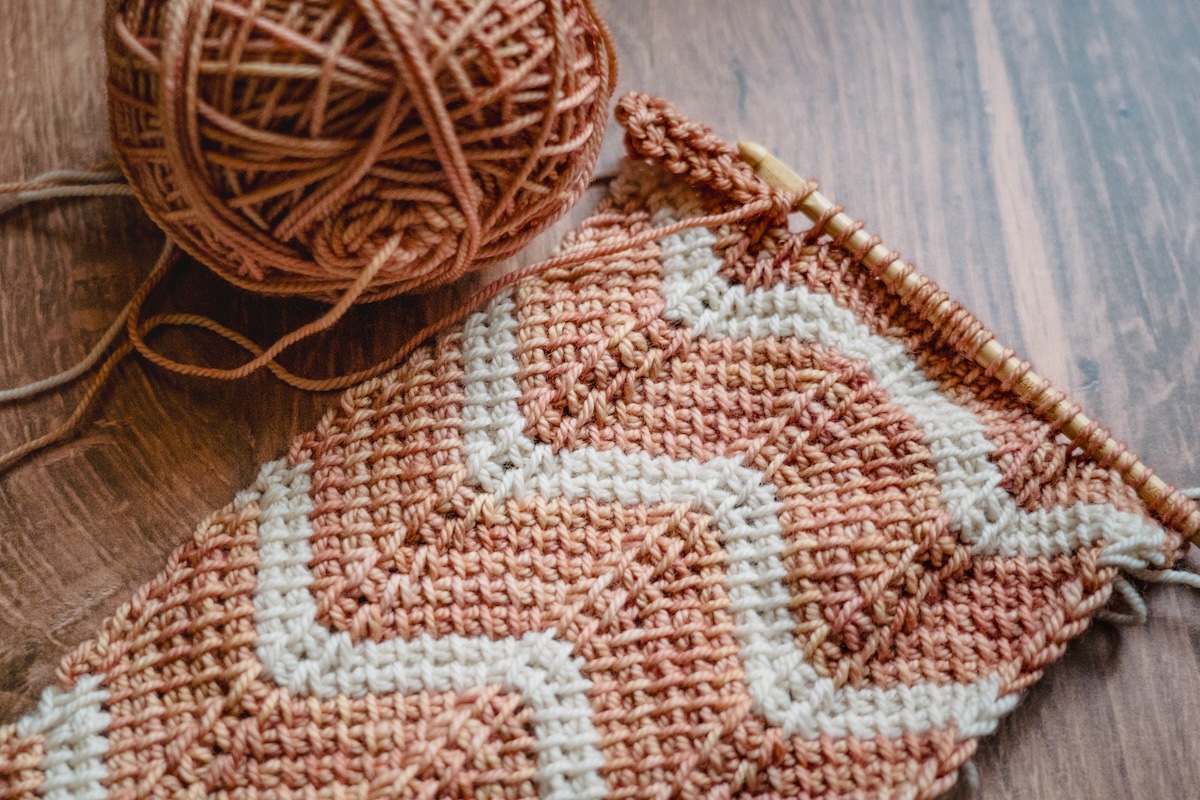
The next challenge for me was how to read my crochet fabric. With the Juvie Cowl pattern, there are some spots where you crochet two together, which is pretty intuitive, and there are other spots where you do a yarn over to create a new stitch. The combination of decreases and increases creates a chevron pattern in the fabric.
Now, the first time I tried making this cowl, I didn’t always know where to insert the crochet hook. I didn’t know where the yarn over was creating a new stitch. It was only after about 10 rows that I figured out how it’s supposed to work. Part of me thought I should keep going and ignore all previous mistakes, but I was sitting in the car with an 8-hour-long drive as the passenger, so I had time to rip it out and start over.
Starting over sounds frustrating, but honestly, it was really freeing. When I started again, this time, I was able to pay close attention to exactly what was happening when I created a yarn over. I knew exactly where the hook needed to go after that increase row. By slowing down and watching carefully, I could see exactly what was happening. I completely understood exactly where the hook belonged, how the stitches were structured, and how the increases actually worked.
Here’s the thing: once you see it, there’s no way to un-see it. That knowledge is now mine; it lives in my hands and in my eyes.
What I’ve Learned (So Far)
If there is one takeaway from this whole experience, it’s this: trying and trying again is part of the process. It is a journey. It is natural to want things to be perfect on the first try, especially when you are surrounded by gorgeous yarn and beautiful patterns. The truth is, learning a craft (any new craft) takes patience. It takes slowing down, being willing to rip it out, taking a deep breath, and starting again.
If you are thinking about trying Tunisian crochet, or any new technique or craft, here is my advice:
- Go really slow at the beginning, slower than you think you need to.
- Choose materials that make the learning process easier, not harder. Save your gorgeous but challenging yarns for later, when you have the basics down.
- Don’t be afraid to start over. Every time you restart, you are learning something new.
- Just keep going. It will be worth it!
Obviously, I am still very much a beginner at Tunisian crochet, having only learned ONE stitch pattern! I have a lot more to learn, but I am enjoying making this Juvie cowl, and I love the colours that I’ve chosen.
Have you tried Tunisian crochet? Do you have suggestions or ideas for patterns or projects? I’d love to hear about. Or are you learning a new craft right now, too? Tell me all about your beginner stories! I’m all about being a beginner again!
The post New Year, New Craft: I’m Learning Tunisian Crochet appeared first on SweetGeorgia Yarns.


