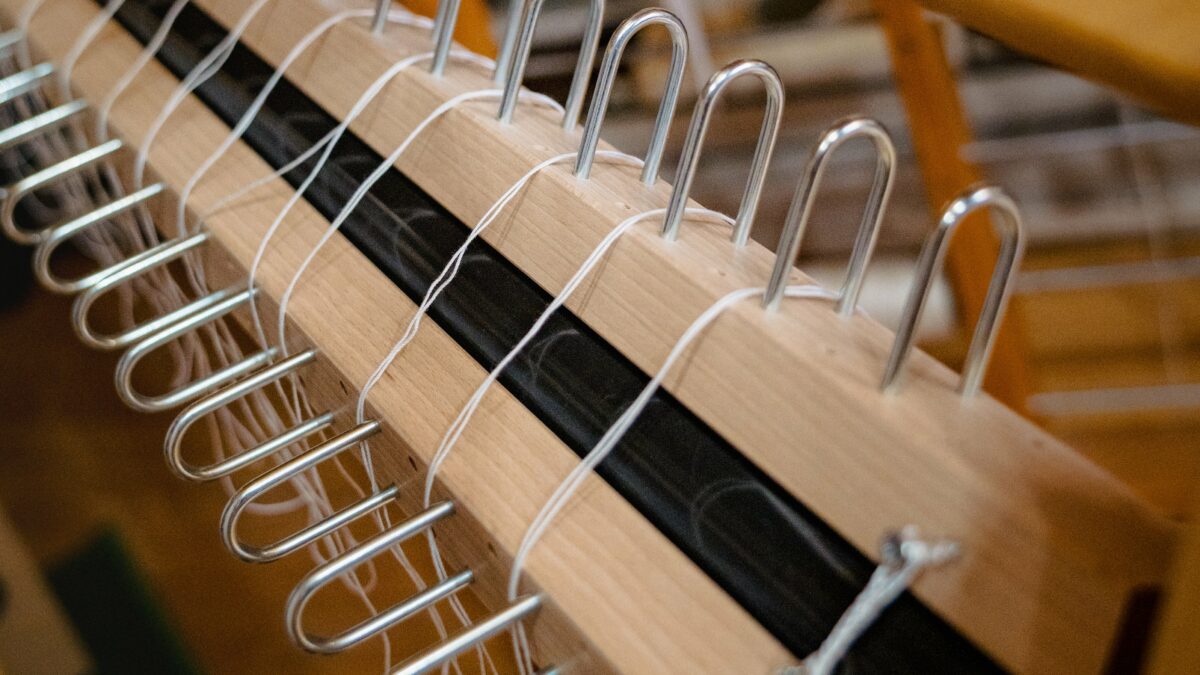
About two Christmases ago, I decided to treat myself and ordered a sectional warp beam for my loom. I must have been rushing, because I ordered it in centimetres instead of inches. For the past few years, I’d grown comfortable weaving in imperial — measuring everything in ends per inch and winding one- or two-inch sections on my other looms. So when the beam arrived with two-centimetre sections instead of two-inch sections, I was put off enough that I let it sit in my attic for over a year before I worked up the nerve to figure it out.
I’m happy to report back: converting between metric and imperial was far less daunting than I’d feared. If you find yourself in the same spot, you can do this too. The questions I had at the start were simple ones. Does the unit system actually matter? Will my fabric come out differently if I measure some things in centimetres and others in inches? Can I still think in ends per inch while measuring in metric — or the other way around?
If you’re someone who uses imperial measurements but finds yourself working with a loom manufactured in Europe (like a Glimåkra or Louët), where everything is metric, I hope this helps.
Why We Have Two Systems in Canada
North American Influence
Living in Canada, I learned to weave from North American references and instructors, so the standard I absorbed was ends per inch (EPI). Ends per inch describes how many individual warp ends fit into one inch of woven cloth, and it drives nearly every decision you make: which reed you choose, how wide you wind your warp, and how many ends you beam.
This measurement is deeply embedded in North American weaving tradition. You’ll find it in everything from Schacht manuals to Handwoven magazine, the books of Madelyn van der Hoogt to Deborah Chandler’s Learning to Weave — one of the books I learned from, where everything is measured in EPI. It simply became second nature. I feel like I inherently understand what 10 EPI in plain weave and 12 EPI in twill look and feel like.
European Influence
But living in Canada has always brought a little friction here, because we measure everything else in metric — as do most European countries. There, the equivalent measurement is ends per centimetre (EPCM). The logic is identical — warp ends per unit of measurement — but the unit is a centimetre rather than an inch.
At the School of SweetGeorgia, we’ve always offered our weaving patterns in both systems, EPI and EPCM. For a long time, one of our weaving tech editors, Amanda Buckley — an Australian then living in Sweden — worked hard with us to make sure both sets of measurements were listed clearly and accurately in every pattern. We created a standard where we noted how measurements were taken and in which unit system, so that we could accurately convert between the two and offer precise and correct information through the pattern instructions.
Sett Isn’t The Only Thing That Differs Between The Two Systems
Reed sizes, warp length, and yarn grist (the relationship between a yarn’s weight and its yardage) all follow either imperial or metric conventions, depending on where they’re written. For example, at SweetGeorgia Yarns, we list all of our yarn details in both “yards per pound” as well as “metres per gram”.
Reeds are another good example. In North America, a 10-dent reed has 10 dents per inch. In Europe, a reed is labelled something like 40/10 — 40 dents per 10 centimetres. These work out to almost the same thing, but not quite. Ten centimetres doesn’t convert to four inches; 10 cm = 3.937 inches. Divide 40 dents by 3.937 inches, and you get 10.16 dents per inch. Close, but not exact.
Does the Unit System Actually Matter?
In short: no. Your handwoven cloth doesn’t know whether you ran your calculations in centimetres, millimetres, or inches. What does matter is staying consistent — mostly for your own record-keeping.
Those tiny differences might not seem like they matter, but they do add up. The gap between 10 EPI and 10.16 EPI is unlikely to show. But with a very fine yarn at 60 EPI, the same conversion gives you 60.96 EPI on a metric reed — a difference of nearly a whole thread. It may feel insignificant in the cloth but the measurement still isn’t quite the same.
Converting between EPI and EPCM rarely produces clean whole numbers, so some rounding is unavoidable. Generally, rounding up or down won’t make a dramatic difference — I round up for sett when I want a slightly looser fabric, and down when I want something firmer. When I weave with fingering-weight knitting yarn, 10 often feels too loose and 12 too tight; 11 would be perfect. But good luck finding an 11-dent reed, so some fudging and compromise come with the territory.
My Best Practices
A few years ago, when I built my digital record-keeping system for weaving projects (in ClickUp!), I had to settle on a consistent way to track measurements and calculations. It’s genuinely a bit of a struggle, because I want to think in inches but measure in centimetres. Here are the guidelines I landed on:
Reeds
The reeds I own from Canada and the US are listed in dents per inch, and reeds from Europe are listed in dents per 10 cm. In my records, I always try to make a note of which reed I’m using. To convert a metric reed to imperial, divide the metric number by 3.937 — so a 30/10 metric reed equals 7.6 dents per inch. Close to 8, but not exactly.
Measurements
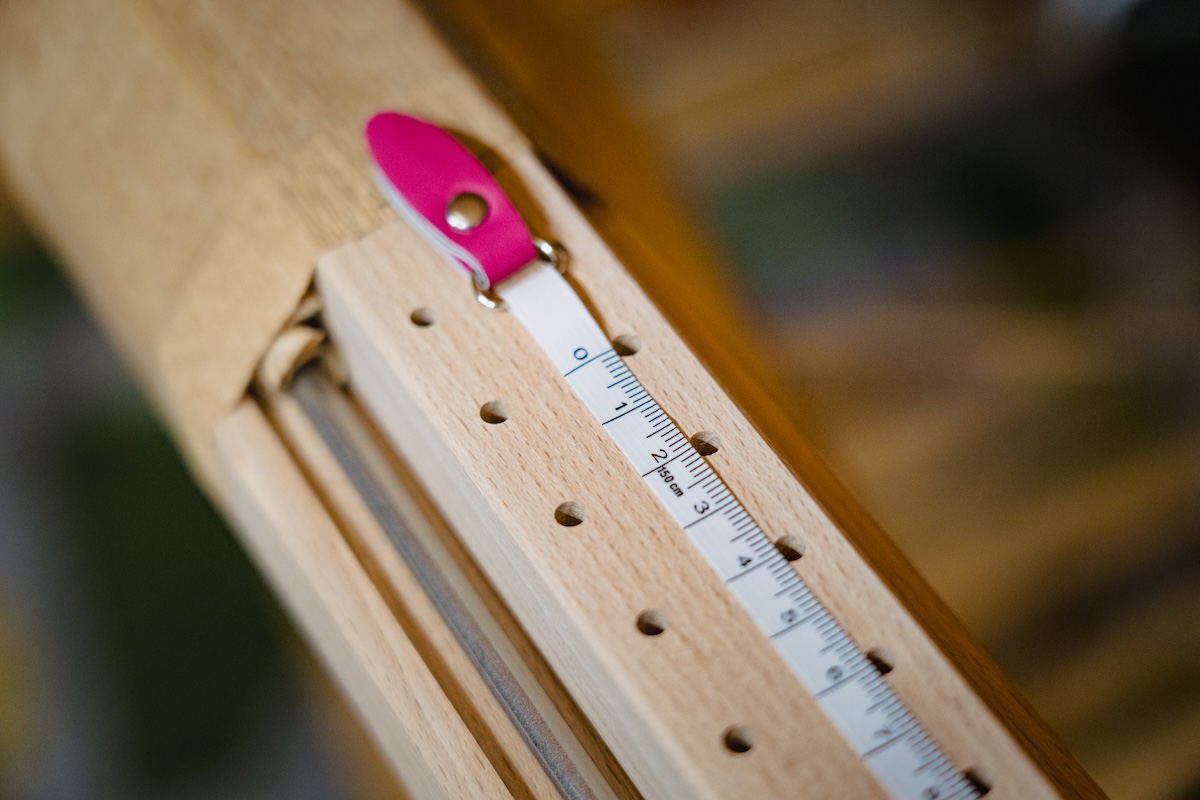
I do all my cloth measurements in centimetres, which makes the rest of my calculations easier — it’s much simpler to work with 2.85 cm in calculations than its equivalent, 1 5/16″. Then, once the math is done, I convert back to inches, because my brain reads inches more intuitively. I have a gut sense for how big 8 1/2″ is, since I handle letter-size paper all the time. Ask me to picture 21.59 cm, and I’m stumped — even though it’s the exact same size.
So What Did I Do With My Metric Sectional Warp Beam?
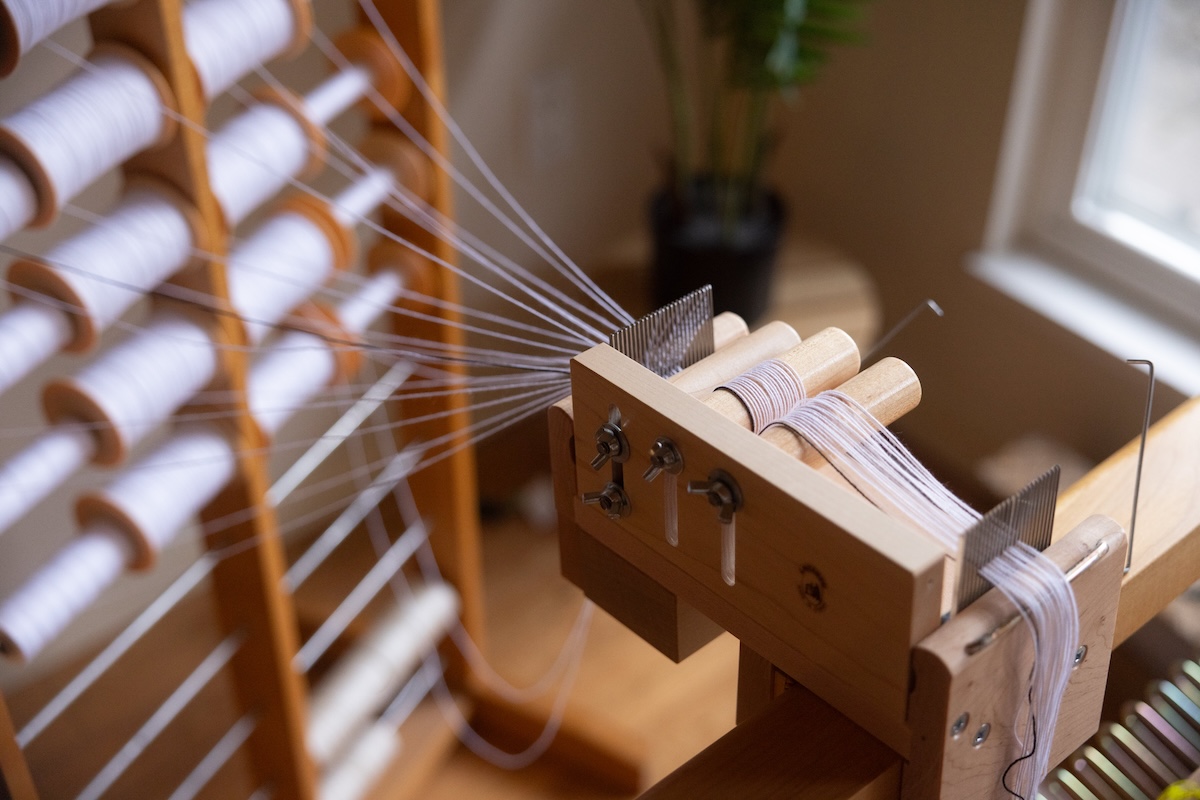
Earlier this year, I made a YouTube video where I showed how I built the sectional warp beam and fitted it to the back of my Louët Spring loom. I installed the rakes into the sectional beam to create 4-cm-wide sections — roughly 1.5748 inches each. For my twill kitchen towel project, I wanted to sett my 8/2 cotton at about 20 EPI, so I had to scale that up from a 1-inch section to a 1.5748-inch section, which gave me about 31.496 warp ends per section. I rounded to an even number and wound 32 ends per 4-cm section. This project was the basis of my research for an upcoming article in WEFT magazine, coming out this fall.
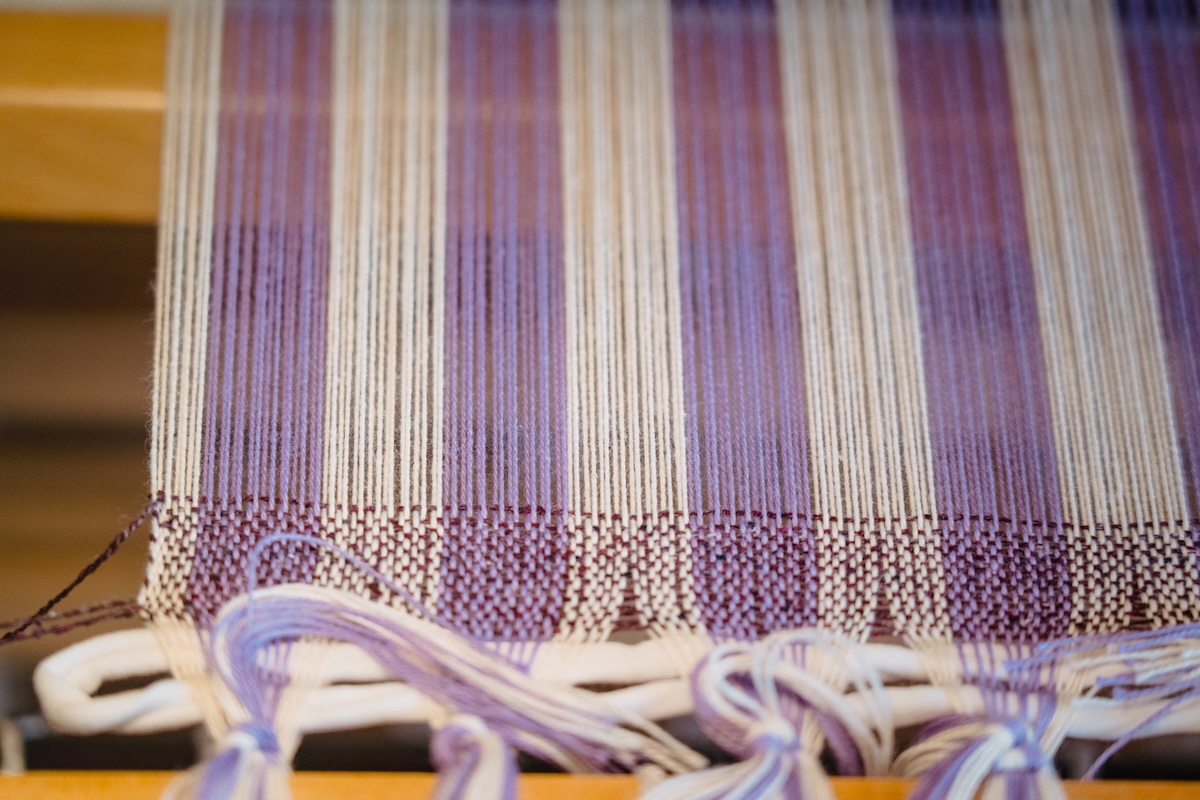
After threading the heddles, I sleyed a standard imperial 10-dent reed at 2 ends per dent, producing a clean 20 EPI warp. Had I used a 40/10 reed instead, I’d have ended up at 20.32 EPI.
Again, these differences are minute. But it’s good practice to record exactly what happened at your loom, as precisely as you can, right from the start. Those records serve as your reference for future projects, so you want to make sure you’re measuring and keeping track of the right numbers!
The post Metric or Imperial? A Weaver’s Guide to Converting EPI & EPCM appeared first on SweetGeorgia Yarns.